How to charge an electric car at home
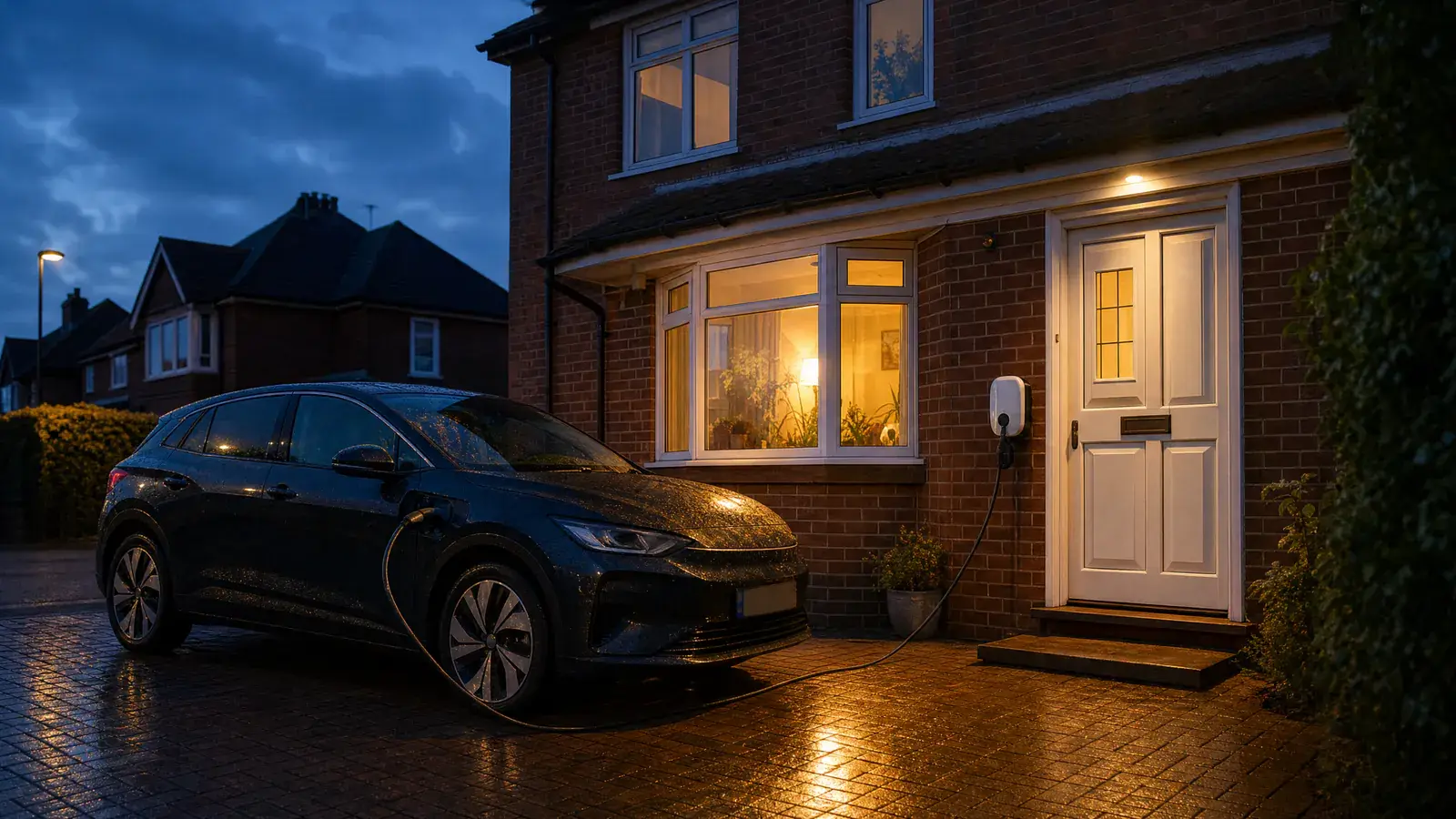
Most drivers charge overnight at home. A fitted 7.4kW smart charger adds about 25 miles of range an hour and, on an EV tariff, costs 2p to 3p a mile against 20p for petrol. This guide takes you from your first question to your first charge.
Updated 10 October 2026Facts checked 10 October 2026 against primary sources8 min read
The short answer
- Fastest home option
- 7.4kW wall charger
- About 25 miles of range an hour. Typical fitted price £949-£999.
- Slowest option
- 3-pin, 2.3kW
- About 8 miles an hour at 10A. For occasional use only.
- Home cost per mile
- 2.0p-2.9p
- On an EV tariff. 7.9p on the standard capped rate, 23.8p at a public rapid charger, 19.9p for petrol.
- Time to get one
- 1 to 6 weeks
- Enquiry to install. The visit takes 2 to 4 hours.
- Grant
- 75% up to £500
- For renters, flat owners and on-street households, until 31 March 2027. Not for houses with a driveway.
If you can park off the road, a fitted 7.4kW smart charger plus an EV tariff is the cheapest and simplest way to run an electric car. Get free installer quotes or read on.
Figures checked on 10 October 2026.
The three ways to charge at home
You charge an electric car by connecting a cable from a power source to the car’s charge port. At home you have two real choices and a third, the public network, for when home is not possible.
| Method | Power | Range added per hour | Cost | Best for |
|---|---|---|---|---|
| 3-pin socket with a Mode 2 cable | 2.3kW at 10A | About 8 miles | £68-£160 for the cable | Emergencies, holiday homes |
| Fitted smart wall charger | 7.4kW | About 25 miles | £949-£999 fitted | Anyone who charges at home regularly |
| Public chargers | 7kW to 22kW AC, 50kW and above rapid | Varies | 54p to 79p per kWh | When home charging is impossible |
Home charging options compared. Range per hour is our arithmetic at 3.32 miles per kWh, ignoring charging losses.
To see what that means in practice, the average battery-electric car in England covers about 9,400 miles a year, or 26 miles a day by our arithmetic. A 7.4kW charger replaces that in about 1.1 hours. A 3-pin socket takes about 3.4 hours, every day, through a socket and wiring that Electrical Safety First says are not designed for that load and duration. That is why the 3-pin route belongs in the boot as a backup. Our 3-pin charging guide and portable charger guide cover the limits and the safe way to use one. For times by battery size, see how long it takes to charge an electric car.
Your car’s charge port decides the cable. Most UK cars use a Type 2 port for AC charging at home, with CCS for rapid DC charging, according to Zapmap, while a few older cars use Type 1. Our guide to charger and connector types explains the rest, and Type 2 charging cables covers the lead if you buy an untethered charger.
What you need before you start
Somewhere to park off the road. A driveway or garage is the straightforward case. Without one, read our guides to charging without a driveway and cross-pavement charging.
Permission. Renters and flat owners need written consent from the landlord or freeholder, because the law gives no right to charge. See our guide for flats and renters.
A supply that can cope. Most installers check your meter, consumer unit and fuse from photos. Every installation must be reported to the network operator, which the installer does at no charge to you. For a normal home they connect first and notify within 28 days. A looped supply or an older, smaller main fuse needs the operator’s approval first, which adds weeks but is usually free.
A smart meter, if you want a cheap tariff. EV tariffs need half-hourly readings.
Choosing a charger
Almost every home charger is single-phase at 7.4kW, because most UK homes cannot supply more without a costly upgrade. Every one sold new in Great Britain is smart by law, so it can follow a schedule (the rules explained). The real choices are tethered or untethered, whether you have solar, and which tariff you want. Our tethered versus untethered guide deals with the first, and the best home chargers page ranks the market. Four popular models, side by side:
| Feature | Ohme ePod | Ohme Home Pro | Hypervolt Home 3 Pro | myenergi zappi |
|---|---|---|---|---|
| Price fitted (from) | £949 | £999 | £1,099 | £949 |
| Charger only | £498 | £532 | £690 | £779 |
| Power | 7.4 kW | 7.4 kW | 7.4 kW | 7.4 kW (22 kW three-phase) |
| Cable | Untethered (socket) | Tethered, 5 or 8 m | Tethered, 5 or 7.5 or 10 m | Tethered (6.5 m) or untethered |
| Intelligent Octopus Go | Yes | Yes | Yes | Yes |
| Solar charging | Yes (CT clamp) | Yes (CT clamp) | Yes (CT clamp) | Yes (CT clamp) |
| Built-in PEN fault protection | Yes | Yes | Yes | Yes |
| Connectivity | 4G | 4G | WiFi, Ethernet, Bluetooth | WiFi, Ethernet |
| Weather rating | IP54 | IP55 | IP66 | IP65 (install guide requires IP65 glands; Yesss listing says IP65) |
| Warranty | 3 years | 3 years | 3 years | 3 years |
Prices are the lowest published with a standard installation. Prices and specs checked 10 October 2026 from manufacturers and UK retailers.
If you plan to use Intelligent Octopus Go, check that the charger is on Octopus’s list. Ohme, Hypervolt, myenergi zappi, Andersen A3, Wallbox Pulsar Max and Indra Smart PRO are generally available in Octopus’s live data. For solar, the zappi’s surplus-only mode is the usual starting point: see charging with solar panels.
How to get a charger installed
Check you can fit one1 day
Confirm you have parking you control and, if you rent or live in a flat, written permission. Check whether you qualify for the grant: 75% up to £500 for renters, flat owners with private parking and on-street households. Homeowners with a driveway do not.
Get two or three quotes1 week
Most installers survey from photos of your meter, consumer unit and the charger location. Ask what cable length is included, whether VAT is in the price and what is excluded, such as trenching or a new consumer unit.
Choose an installer you can check
Pick a registered electrician on a competent person scheme such as NICEIC or NAPIT, and OZEV-authorised if you want the grant. Members of the EV Consumer Code give at least a three-year workmanship guarantee and should not ask for a deposit above 15%.
Install day2-4 hours
A standard job takes two to four hours. The installer fits a dedicated circuit, mounts the charger, tests it and tells the network operator.
Collect the paperwork
You should receive an Electrical Installation Certificate and a Building Regulations compliance certificate. Tell your home insurer. The ABI says hard-wired chargers and tethered cables are generally covered by buildings insurance.
Set up the app and your tariff
Connect the charger to Wi-Fi or 4G, enter your car, and link your tariff. Switch before the first charge, not after.
Enquiry to installation usually takes one to six weeks, and most national providers quote three to six. The standard job covers the charger, a dedicated circuit and a cable run of 5m to 15m, depending on the provider. Extras are the usual surprises: extra cable at £10 to £20 a metre, trenching at £200 to £500, and a new consumer unit at £350 to £1,000. Our installation cost guide itemises them.
Switch to an EV tariff
The charger is only half the saving. The standard variable rate is 26.32p per kWh under the Ofgem cap, while EV tariffs give a cheap rate for several hours overnight.
| Tariff | Off-peak rate | Cheap hours | What you need |
|---|---|---|---|
| EDFGoElectric 12m v3 | 6.66p | 23:00-06:00 every night (7 hours, whole home). | Any EV and any charger (brand-agnostic). |
| Octopus EnergyIntelligent Octopus Go 12M Fixed (October 2026 v1) | 7.6p | 23:30-05:30 every night for the whole home (local time). | Compatible car (over 280 cars) or compatible charger; Octopus integrates with the car in preference to the… |
| E.ON NextNext Drive Smart (V7.6) | 8.1p | 00:00-06:00 every night (6 hours, whole home). | Supported EV (list includes Tesla, BMW, Audi, CUPRA, Ford...) or supported charger: zappi, Hypervolt, Indra. |
| Octopus EnergyOctopus Go 12M Fixed (September 2026 v2) | 9.5p | 00:30-05:30 every night (5 hours, whole home). | An electric car charged at home. |
| British GasEV Power (Mar28 v3) - sometimes marketed as 'Electric… | 9.5p | 00:00-05:00 every day (35 off-peak hours a week), whole home. | Any make of EV and home charger; Hive charger needed only for Power+ |
A selection of EV tariffs; more are in our full tariff guide. Rates per kWh for new customers, read on supplier pages on 10 October 2026. Domestic electricity is zero-rated for VAT in Great Britain from 1 October 2026 to 31 March 2027. Standing charges vary by region.
Four things to know before you switch:
- You need a smart meter. New customers usually start on a standard tariff and move to the EV tariff once the meter reports.
- The day rate is high. Intelligent Octopus Go’s day rate runs from 34.96p to 38.82p, and standing charges are 42p to 67p a day. A low-mileage, daytime-heavy home can lose out: with 2,500kWh of house use all at day rates, it beats the cap only above about 4,570 miles a year.
- Exit fees vary. Octopus charges £50, EDF £75 and E.ON Next nothing.
- Smart tariffs can be withdrawn. E.ON says it can remove you if you do not use smart charging consistently.
Where it fits, the saving is real. On a house using 2,500kWh and an EV doing 9,400 miles, Intelligent Octopus Go saves about £272 a year against the capped rate, or £490 if you shift 30% of house use into the cheap window. See Intelligent Octopus Go and the full EV tariff comparison.
What home charging costs
| Where you charge | p per kWh | Pence per mile | Per year |
|---|---|---|---|
| Home, EDF GoElectric off-peak | 6.66 | 2.0p | £188 |
| Home, Intelligent Octopus Go | 7.6 | 2.3p | £215 |
| Home, E.ON Next Drive Smart | 8.095 | 2.4p | £229 |
| Home, Octopus Go Fixed | 9.5 | 2.9p | £269 |
| Home, standard tariff at the price cap | 26.32 | 7.9p | £745 |
| Public standard AC post (3 to 49kW) | 54 | 16.3p | £1,528 |
| Public rapid or ultra-rapid (50kW and above) | 79 | 23.8p | £2,235 |
| Petrol car at 40mpg | - | 19.9p | £1,868 |
Cost per mile at 0.301 kWh per mile, with annual cost at 9,400 miles. Domestic electricity is zero-rated for VAT in Great Britain to 31 March 2027; public charging carries 20% VAT.
The capped standard rate costs about 3.5 times as much per mile as Intelligent Octopus Go, and a public rapid charger about 10 times as much. Rapid charging costs about 20% more per mile than petrol at 40mpg at today’s pump price. The figures assume the EV Database average of 0.301 kWh a mile, and the source does not say whether that includes charging losses, so treat the home figures as slightly optimistic. They also exclude the charger itself. Our home charging cost guide and charging cost calculator let you run your own mileage.
Your everyday routine
Plug in when you park. The charger and tariff do the rest, and you tell the app when you need the car ready. Ohme advises checking that the charger is online before you plug in, and that the session reads “Scheduled” or “Smart charging”. If you ever see a charger that does not start, our troubleshooting guide walks through the checks.
Never use an extension lead. The Renewable Energy Consumer Code says not to, and the RAC says rain does not stop charging, but a storm is a time to wait. Your car’s handbook sets the maker’s advice on day-to-day charge limits. The RAC notes that rapid chargers slow down once the battery is more than 80% full, so on journeys stopping at 80% saves time.
If you cannot charge at home at all, the cost picture changes: public rapid charging at 79p per kWh is dearer per mile than petrol. Our no-driveway guide lists the alternatives.
Questions people ask
How do you charge an electric car?
Can you charge an electric car at home with a normal plug?
What is the 80/20 rule for charging electric cars?
Should I charge my EV to 100% every night?
Is it okay to leave an EV charger plugged in all the time?
Can you charge an electric car in the rain?
Sources
- Electric car charging: how it works and how much it costs, RAC (read 10 October 2026)
- Connector types, Zapmap (read 10 October 2026)
- UK EV Charging Price Index, Zapmap (read 10 October 2026)
- Energy price cap unit rates and standing charges, Ofgem (read 10 October 2026)
- Intelligent Octopus Go 12M Fixed, October 2026 (product API), Octopus Energy (read 10 October 2026)
- GoElectric, EDF (read 10 October 2026)
- Next Drive Smart, E.ON Next (read 10 October 2026)
- Fuel and power (VAT Notice 701/19), HMRC (read 10 October 2026)
- NTS0901 Annual mileage of cars by ownership, fuel type and trip purpose: England, Department for Transport (read 10 October 2026)
- Energy consumption of full electric vehicles cheatsheet, EV Database (read 10 October 2026)
- Weekly road fuel prices, DESNZ (read 10 October 2026)
- Connecting electric vehicles and heat pumps, Energy Networks Association (read 10 October 2026)
- EV Consumer Code, consumers, EV Consumer Code (read 10 October 2026)
- EV chargepoint grant for renters and flat owners, GOV.UK Find a Grant (read 10 October 2026)
- Electrical safety advice for electric vehicles, Electrical Safety First (read 10 October 2026)
- Electric vehicle charging: what it means for home and motor insurance, Association of British Insurers (read 10 October 2026)
- Electric car charging at home, Which? (read 10 October 2026)
Read next
- The best home EV chargers in the UK, 2026Our pick of the best home EV chargers in the UK for 2026, compared on installed price, smart features, solar and tariff support, with clear verdicts.
- EV charger installation in the UK: how it works, what it costsHow home EV charger installation works in the UK: survey, what is included, how long it takes, what it costs and how to find a competent installer.
- Best EV tariffs in the UK, comparedCompare the best UK EV tariffs: off-peak rates, charging windows, standing charges and requirements for Octopus, EDF, E.ON, British Gas and more.
- EV charger and connector types in the UKEV charger types explained for UK drivers: 3-pin, 7kW wallbox, 22kW, smart, solar and V2G chargers, plus Type 1, Type 2, CCS and CHAdeMO connectors.