EV charger installation in the UK: how it works, what it costs
A home charger is fitted by a registered electrician in one visit of two to four hours, after a photo survey. This is the whole process, from who is allowed to fit one to the certificates you should hold afterwards.
Updated 10 October 2026Facts checked 10 October 2026 against primary sources12 min read
The short answer
- Who can fit it
- A registered electrician
- On a competent person scheme (NICEIC/Certsure, NAPIT and others). OZEV-authorised too if you want the grant.
- Time on site
- 2 to 4 hours
- Pod about 2, Ohme 2 to 4, British Gas 3 to 5, Octopus about 4.
- Enquiry to install
- 1 to 6 weeks
- Most national providers quote 3 to 6 weeks.
- Charger and standard install
- £949–£999
- Install only: £399–£490. Extras are priced on our cost page.
- Network operator (DNO)
- Always told
- Usually within 28 days after fitting. Before fitting if your supply is looped or you need over 60A.
- OZEV grant
- 75% up to £500
- Renters, flat owners, on-street households. Not owner-occupied houses with a driveway. Ends 31 March 2027.
You should finish with an Electrical Installation Certificate, a Building Regulations compliance certificate and proof the network operator was notified.
Figures checked on 10 October 2026.
Installing a home EV charger is a small electrical job with a lot of paperwork around it. The work is quick. What separates a good installation from a poor one is who does it, what they check beforehand and what they leave you with afterwards. This page follows the job in order and says where the rules differ in Wales, Scotland and Northern Ireland.
Who can install a home EV charger
In England a new charger circuit is notifiable under the Building Regulations (reg 12(6A) of the 2010 Regulations, Part P). The practical consequence is that you want an electrician registered with a competent person scheme. They self-certify the work, so you do not need a separate council application. GOV.UK (updated 17 September 2026) lists the electrical schemes for dwellings as BESCA, Blue Flame Certification, Certsure (trading as NICEIC), NAPIT and OFTEC. An installer who is not registered must notify building control before work begins, which adds cost and delay.
Three other labels cause confusion.
OZEV-authorised matters only if you claim the grant. The installer must belong to a competent person scheme or the ECA, hold £2 million public liability insurance, notify the network operator in writing, issue a BS 7671 Electrical Installation Certificate and keep the documents for three years. It is not a general legal requirement for installing a charger.
MCS does not apply. The Microgeneration Certification Scheme covers solar panels, heat pumps, biomass and battery storage, not EV chargepoints. An installer who says you need an “MCS charger” is mistaken.
The EV Consumer Code is voluntary but worth having. Members must give a workmanship guarantee of at least three years with insolvency protection, should not ask for a deposit above 15%, must show evidence the network operator was notified, and may only fit smart chargers that meet the 2021 regulations.
The rules differ across the UK. Wales has an older and wider regime in which a new circuit is also notifiable. Scotland uses building standards and warrants rather than Part P; work to a house usually needs no warrant, but it must still comply and your electrician should issue an Electrical Installation Certificate. Northern Ireland has no equivalent of Part P, so choosing a registered, insured installer is down to you. If you are tempted to do the job yourself, read how to install an EV charger first.
Permissions before you book
Planning. In England a wall-mounted charger on a driveway is normally permitted development: the unit and casing must be no more than 0.2 cubic metres, and it cannot be on a scheduled monument or within a listed building’s curtilage. The old rule against facing the road within 2 metres was removed on 29 May 2025. From 21 October 2026 a 1.6 metre height cap applies and there are new rules for homes without a driveway. Check for an Article 4 direction if you live in a conservation area. Our planning permission guide has the detail, including Wales, Scotland and Northern Ireland.
Landlords and freeholders. There is no right to charge in the UK. The Renters’ Rights Act 2025 contains no EV provision, despite blog posts that say otherwise. If you rent or own a flat, you need written permission, and OZEV needs it before you apply for the grant.
Insurance. Tell your home insurer before the install. Ageas says a charger usually does not raise the premium, but it is wise to check. The ABI says a hard-wired charger and its tethered cable are generally covered under buildings cover, while untethered cables are usually treated as motor accessories, and many policies are silent.
No driveway? You need a council-approved pavement channel, not a cable across the footway. Our no-driveway guide explains the permissions and costs.
The survey: photos or a visit
Most national providers survey remotely. Octopus, British Gas, OVO, Pod, Ohme, Andersen (standard) and Charge At Home ask you to upload photos, and in most cases no one visits first. Bristol Phoenix, Faithful Spark, Lilliput (a free 15-minute survey) and Andersen Premium visit in person, and some installers charge for a visit (published fees run £60–£99). Smart Home Charge gives an instant quote without any survey, based on the simplest installation, so that figure is a minimum.
The providers’ survey forms say exactly what they need, but expect to photograph:
- the electricity meter and the main fuse (the cut-out) beside it;
- the consumer unit (fuse box), closed, showing where it is in the house;
- the wall or spot where the charger will go; and
- the route the cable would take between them.
Two details are worth knowing early. Pod’s standard install needs the fuse box on the ground floor. Octopus requires a fused isolator if the consumer unit is more than 3 metres from the meter or the meter-to-unit cable changes. Photos let an installer spot both before they arrive.
A proper survey also covers things photos cannot show: your earthing arrangement, maximum demand and whether the supply is looped. Electrical Safety First’s August 2026 survey of more than 3,000 households found fewer than one in four considered whether their home’s electrics were ready for EV charging. Do not be one of them.
What happens on the day
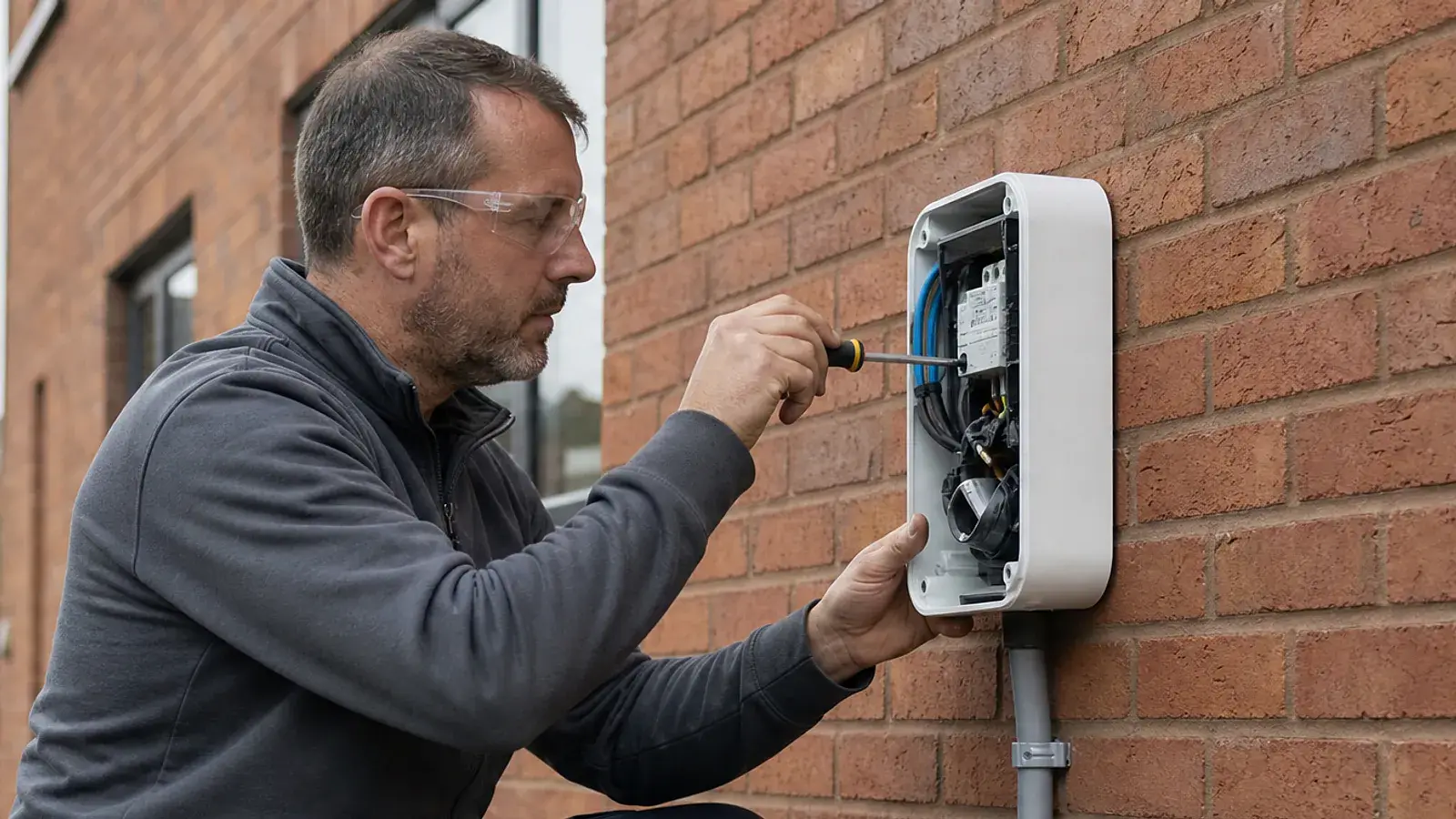
A standard visit takes about two to four hours. Pod says about two, Ohme two to four, British Gas three to five and Octopus roughly four. The installer will normally:
- mount the charger on a brick or rendered wall;
- run a dedicated cable from your consumer unit, clipped or in trunking, through one wall;
- fit protection on the new circuit, including a 30mA RCD with DC fault protection;
- connect, test and commission the charger, including the app and Wi-Fi or mobile connection;
- complete the certificates and walk you through use.
They need to isolate your supply to connect to the consumer unit, so plan around it. Included cable runs from 5 metres at Charge At Home and LAMPS to 15 metres at Pod, Ohme and Andersen; see what is covered before comparing quotes.
The electrical rules behind that list are BS 7671 Section 722. It requires a dedicated final circuit, a 30mA RCD with protection against smooth DC leakage, and outdoor equipment rated at least IPX4 and IP4X with an impact rating of IK08. Amendment 4 was published on 15 April 2026 and the previous version is withdrawn on 15 October 2026. Nothing in it changes what a standard home install looks like. If your cable passes through a wall between an attached garage and the house, the hole should be fire-stopped; a competent installer does this as standard.
Telling the electricity network operator
Every EV charger installed at an existing property must be reported to the network operator (the DNO). The Energy Networks Association puts it plainly: “Under all circumstances there is a requirement to inform the network operator.” Your installer does this through ENA Connect Direct, the national online portal launched on 7 May 2024, which auto-approves about 40% of applications.
There are two routes.
Connect and notify is the normal one. If the home’s maximum demand including the charger is 60A per phase (13.8kVA) or less, the supply is adequate and no exclusion applies, the installer fits the charger first and notifies within 28 days.
Apply first applies when new maximum demand is 60A to 100A (the DNO answers within 10 working days), when the main fuse rating is unknown or inadequate, when the supply is looped or unmetered, when more than one new item is going in, or when a heat pump is installed alongside the charger.
A looped supply is a shared service cable that feeds your house and a neighbour’s. Standard unlooping is free to you, because DESNZ reports that all DNOs socialise the cost. It takes 3 to 12 weeks if uncomplicated and up to six months to a year if neighbours dispute it. SSEN says about 16% of homes in its area are still looped. Octopus says the unlooping can often be completed after your charger is in.
Main fuse upgrades are usually free too. UK Power Networks upgrades 30A or 60A fuses to 80A or 100A free of charge and Northern Powergrid says “in most cases”. Citizens Advice found one £200 “assessment and design fee”, and 22% of people with a low-carbon technology needed a fuse upgrade, so ask what your installer expects.
A standard charger carries no DNO application fee, and since 1 April 2023 EV chargepoints are not charged for network reinforcement. Northern Ireland is different: NIE Networks assesses your supply before the charger goes in. Ask for proof of notification.
Earthing and PEN faults
Most UK homes have PME earthing, in which the supply neutral also acts as earth. BS 7671 does not allow a PME supply to feed an outdoor charge point unless the charger or a separate device detects an open-PEN fault, or an earth electrode is fitted. Most mainstream smart chargers have the protection built in, so no earth rod is needed. Some do not: Tesla’s Wall Connector needs an external device. Ask your installer in writing which solution they propose and why. The detail, and what each option costs, is in our PEN fault and earthing guide.
Certificates and paperwork you should receive
By the end of the job you should have:
- An Electrical Installation Certificate to BS 7671. AD P says registered installers should complete one for every job.
- A Building Regulations compliance certificate. The installer or their scheme must give a copy to you, and to building control, within 30 days. Scotland uses building standards; Northern Ireland has no equivalent.
- Evidence the DNO was notified.
- Warranty registration. Hypervolt, for example, requires the unit to be registered as installed within 48 hours to validate its three-year warranty.
- Grant paperwork, if relevant: OZEV asks for photos of the charger, its serial plate, the parking space and a wide shot of the building.
How long it takes, start to finish
Sort permissions and eligibilitybefore you book
Landlord or freeholder consent if you rent or own a flat. If you want the grant, apply and wait for OZEV to confirm before anything is installed.
Get surveyed and quoted
Upload photos or book a visit, then compare itemised quotes. In-person surveys are often within the same week (Lilliput) or about two weeks (Andersen).
Network approval, if needed
Your installer applies first for a looped supply, a 60A to 100A load or a heat pump. The DNO answers within 10 working days for 60A to 100A. Unlooping takes 3 to 12 weeks.
Installation day2 to 4 hours
Mounting, cabling, protection, testing and commissioning.
Notification and certificateswithin 30 days
The DNO is told within 28 days after fitting. The compliance certificate reaches you within 30 days. The installer deducts any grant from your invoice.
Enquiry to install is typically one to six weeks. Octopus says most go ahead within four to six weeks, British Gas says 74% happen within four weeks, OVO quotes three to six weeks, Andersen two to three, and Eco Wizard about two. Faithful Spark in Aberdeenshire books installs within 5 to 10 working days.
Choosing an installer: a checklist
Whoever you choose, compare at least two or three firm quotes. You can request quotes or browse installers by region. Check each against this list.
Registration. Ask for the competent person scheme and the registration number, then check it on the scheme’s own register.
OZEV authorisation if you plan to claim the grant. Do not assume it.
Consumer protection. Look for the EV Consumer Code: three-year workmanship guarantee, deposit capped at 15%, public liability and professional indemnity insurance.
An itemised written quote. It should state the included cable length, whether VAT is in the price, what happens if a new consumer unit or earth electrode is needed, and who notifies the DNO. Our cost guide shows typical prices for each.
A proper survey that asks about your meter, fuse and earthing, rather than a fixed price with no questions.
Aftercare. Ask who supports the charger and how its warranty works. Check that the charger is a smart model that meets the Smart Charge Points Regulations 2021. If you have not chosen one yet, our best home EV chargers roundup compares them.
Red flags
- A deposit well above 15%, or pressure to pay in full before the survey.
- A claim that you need an “MCS” charger.
- No competent person registration, or reluctance to name the scheme.
- No promise of an Electrical Installation Certificate and compliance certificate.
- Installing before OZEV confirms your eligibility. That can make you ineligible.
- A suggestion to skip DNO notification.
- Insisting on an earth rod without explaining the built-in alternatives.
- A second-hand charger. Electrical Safety First warns that these may be a serious fire risk.
What it costs, in brief
A mainstream 7kW smart charger, fitted, is usually £949–£999. The lowest published price we found is £720, and a standard job without groundworks or supply work rarely tops about £1,500. Fitting a charger you already own costs £399–£490. Extra cable costs £10–£20 a metre, trenching £200–£500, a new consumer unit £350–£1,000 and a three-phase upgrade £1,500–£5,370, while standard fuse upgrades and unlooping are normally free. Prices include VAT only where the provider says so. All of this is itemised, with sources, on the installation cost page.
Grants, in brief
Since 1 April 2026 the OZEV grant pays 75% of the cost up to £500 per socket. It covers renters, flat owners with private off-street parking, and households with only on-street parking that will fit a permanent cross-pavement solution. It does not cover owner-occupiers of a house with a driveway. It runs to 31 March 2027, described as a final year. You apply on Find a Grant, wait for OZEV’s eligibility notice (up to 10 working days) and only then install; the installer claims and deducts it from your invoice. Eligibility, steps and edge cases are on the grants page.
Questions people ask
Can a normal electrician fit an EV charger?
Can you install your own EV charger?
Do you need to tell home insurance about an EV charger?
How much does it cost to install an EV charger?
Do you need permission to install an EV charger?
How long does it take to install an EV charger?
Sources
- Competent person scheme: current schemes and how schemes are authorised, GOV.UK (read 10 October 2026)
- Building Regulations 2010, regulation 12, legislation.gov.uk (read 10 October 2026)
- Approved Document P (2013 edition), GOV.UK (read 10 October 2026)
- Become an OZEV authorised installer, GOV.UK (read 10 October 2026)
- Building regulations (Electrical Safety First), Electrical Safety First (read 10 October 2026)
- Electrical safety advice for electric vehicles, Electrical Safety First (read 10 October 2026)
- Consumers, EV Consumer Code (read 10 October 2026)
- Who we are, MCS (read 10 October 2026)
- Connecting electric vehicles and heat pumps, Energy Networks Association (read 10 October 2026)
- Connect Direct passes half a million applications (14 Sep 2026), Energy Networks Association (read 10 October 2026)
- EVs and heat pumps, NIE Networks (read 10 October 2026)
- What do you need to upgrade?, UK Power Networks (read 10 October 2026)
- Unlooping electricity network connections: research summary (2026), DESNZ / Eunomia (read 10 October 2026)
- Navigating the Network (2026), Citizens Advice (read 10 October 2026)
- Looped service (29 Apr 2026), SSEN (read 10 October 2026)
- BS 7671:2018+A1 (Wiring Matters, March 2020), IET (read 10 October 2026)
- RCDs for electric vehicle supply equipment (Wiring Matters, May 2024), IET (read 10 October 2026)
- Understanding BS 7671:2018 + Amendment 4:2026, NICEIC (read 10 October 2026)
- Electric vehicle charging, what it means for home and motor insurance, ABI (read 10 October 2026)
- How much to install an EV charger at home?, Ageas (read 10 October 2026)
- Explore our EV chargers and EV charger FAQ, Octopus Energy (read 10 October 2026)
- Installation, Pod (read 10 October 2026)
- Smart charging FAQs, Ohme (read 10 October 2026)
- Home EV charger installations with Hive, British Gas (read 10 October 2026)
- Changes to EV chargepoint grant schemes from 1 April 2026, GOV.UK (read 10 October 2026)
- EV chargepoint grant for renters and flat owners, Find a Grant (GOV.UK) (read 10 October 2026)
- Electrical outlet for recharging vehicles (Class D, GPDO 2015), legislation.gov.uk (read 10 October 2026)
- Which? Electric car charging at home (25 Feb 2026), Which? (read 10 October 2026)
Read next
- How much does it cost to install an EV charger at home?What it costs to install a home EV charger in the UK in 2026: standard install vs extras (earth rod, consumer unit, long cable runs), plus grants.
- EV charger grants in the UK: who qualifies in 2026Who can claim the OZEV EV charger grant in 2026, how much it pays, which homes qualify (flats, renters, on-street) and how to apply through an installer.
- How to install an EV charger at homeHow a home EV charger is installed: the steps an electrician follows, what you can prepare yourself, DNO notification, RCBOs and why DIY is a poor idea.
- Do you need planning permission for an EV charger?Do you need planning permission for a home EV charger? Permitted development limits, listed buildings, the driveway rule and the 21 October change.