Cross-pavement EV charging: rules, costs and gullies
A pavement channel lets you charge at home without a driveway, but only where your council allows it. The channel costs £250 to £1,425 depending on where you live, and the OZEV grant covers the charger, not the channel.
Updated 10 October 2026Facts checked 10 October 2026 against primary sources9 min read
The short answer
- Channel, paid by you
- £250-£1,425
- Set by your council. The same Kerbo product ranges that widely.
- Whole project after the grant
- about £850-£2,050
- Channel, fees and charger, minus £500. Computed; extremes £700 to £2,550.
- OZEV on-street grant
- 75%, up to £500
- Pays for the charger, not the channel. Open to 31 March 2027.
- Planning (England)
- Not needed from 21 Oct 2026
- For council-authorised channels outside conservation areas. Highways consent and a street works licence still apply.
Cross-pavement charging is legal only with your highway authority’s consent. Start by asking your council whether it has a scheme: no scheme, no channel.
Figures checked on 10 October 2026.
What a cross-pavement solution is
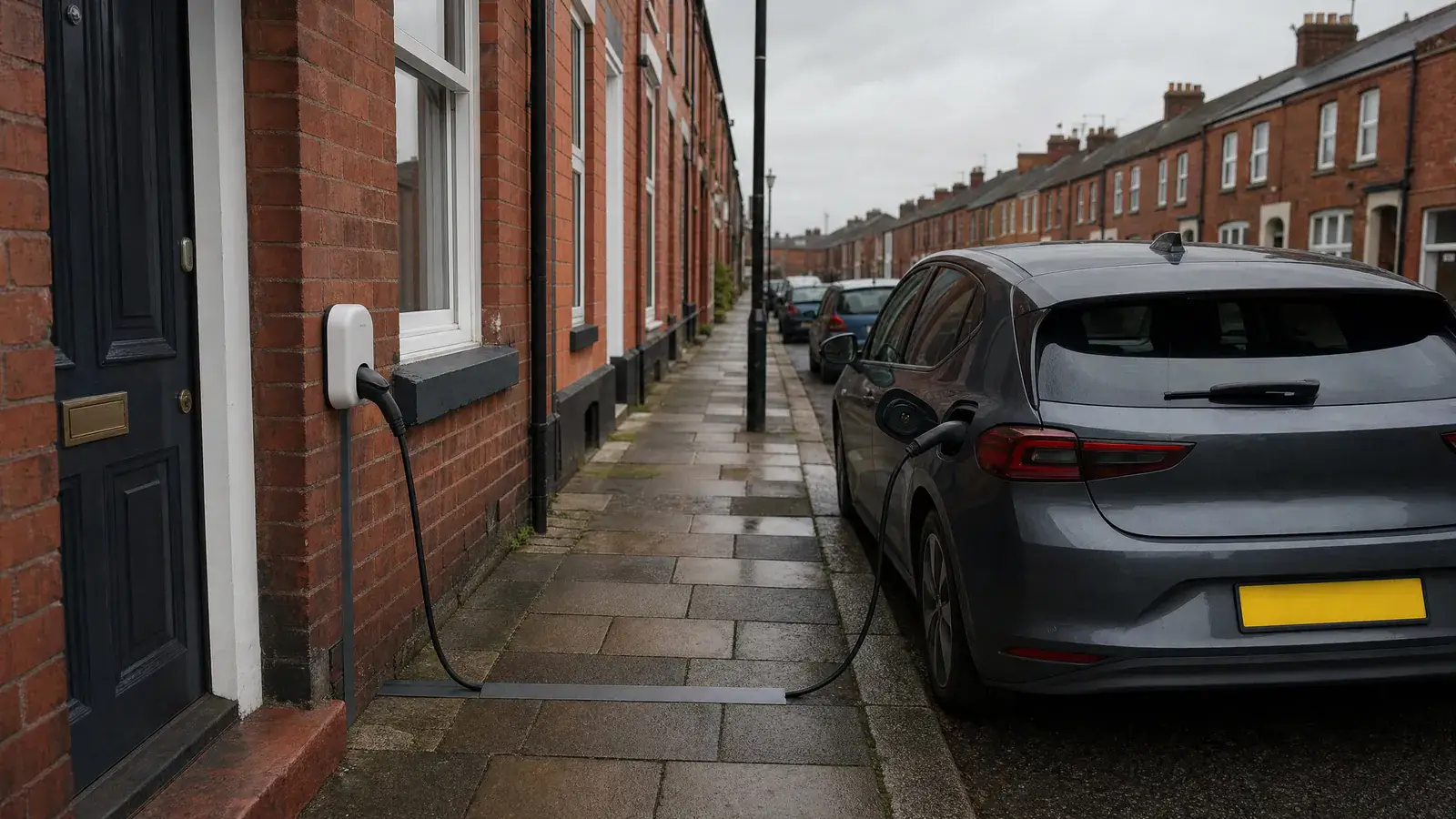
A cross-pavement solution is a channel set into the pavement so that a charging cable can run from your house to a car parked at the kerb without lying across the footway. The new English planning rules define it as “a pavement-embedded cable channel that allows a cable for the recharging of electric vehicles to safely cross a footway from a domestic premises to a parked vehicle”.
Cable covers and rubber mats laid over a trailing cable are not cross-pavement solutions. They do not qualify for the OZEV grant, and most councils ban them. For the wider set of options, including lamp-post chargers, see our guide to charging without a driveway.
Products and prices
The supplier landscape is small and mostly council-led. You rarely buy a channel yourself: the council or its approved supplier installs it and sets your price.
| Product | Design | Where it is used | Price |
|---|---|---|---|
| Kerbo Charge | Plastic flush channel with a self-closing lid; 10-year warranty (supplier claim) | 55 councils live and 22 on trial, per Kerbo’s locations page | No list price; the council sets it. Pod says channel installs “typically start from £399 inc VAT” |
| Gul-e (ODS, owned by Oxford City Council) | Metal channel, no lid; bristles hold the cable | Oxfordshire County Council awarded ODS up to 500 installations, funded by a £700,000 LEVI grant | “From £499 with installation” on a 2023 page; the current ordering page says pricing is “determined on a case-by-case basis” |
| Charge Gully (ChargeDev) | Lockable metal channel | “A few local authorities” on trial, with a waiting list | None published. EVinfrastructure.co.uk reports Kerbo bought it in September 2025 |
| Pavecross | Metal and plastic channel with a rotating closing mechanism, under 80mm deep | “Not live with many authorities” | None published |
| Trojan Home (Connected Kerb) | A flush pavement socket on a permanent underground cable; a subscription, not a channel | Several trials | Subscription; no price found |
| ChargeArm / Nodum overhead arms | Overhead solutions | Highway authorities are “in general dismissive” | Not found |
Cross-pavement products as described by suppliers and councils on 10 October 2026. Design and warranty claims are the suppliers' own.
What councils charge residents
Prices vary because England’s £25 million Pavement Channels Grant paid councils “up to an average of £1,200 per channel”. Councils that applied cut what residents pay. Residents cannot apply for it themselves. Where a council page exists we use it. Kerbo’s location pages are supplier-run and are marked.
| Council | You pay | Notes |
|---|---|---|
| South Gloucestershire | £250 | Non-refundable application fee; nothing more if approved. Conservation areas excluded. |
| Richmond upon Thames | £250 + £150 | Complete installation (reduced from £1,250) plus a three-year licence. Kerbo page. |
| Slough | £399 | Includes VAT; complex sites may cost more. |
| Cumberland | £499 | 50% off £999. Planning £309 where required; £5m public liability cover. |
| Surrey | From £499 | Subject to grant eligibility. Kerbo page. |
| West Berkshire | £799 | Includes VAT and a 10-year warranty. Kerbo page. |
| Bromley | £799 | £100 application plus £699. The council does not supply the charger. |
| Milton Keynes | £832 + VAT | £29 survey fee, refundable if unsuitable. Kerbo page. |
| Newport, Blaenau Gwent, Carmarthenshire | From £832 + VAT | Wales. Kerbo pages. |
| Enfield | £874 + £108 | Plus an application fee; EVinfrastructure.co.uk reports an annual fee of £103. |
| Bolton | £999 | Interest-free monthly payment option. Kerbo page. |
| Hertfordshire (St Albans trial) | £200 + £1,200 | Assessment fee plus installation; both VAT-exempt. |
| Leeds | £1,310 | Includes council fees. Kerbo page. |
| Cambridgeshire | £1,388, or £888 | £1,198 plus a £190 section 178 licence; a £500 council rebate on completion. |
| Suffolk | £1,398 | Includes a £210 council fee. Kerbo page. |
| Manchester City | £949-£1,425 | Depends on the pavement surface. Kerbo page. |
| Cornwall | £184 | Installation “usually completely FREE thanks to a government grant”; the resident pays a licence fee. Kerbo page. |
| Bradford | £900 minimum | Installation at cost, plus a £95 inspection fee and £50 a year. Undated policy document. |
| Northern Ireland | £392.68 licence | Streets Work Licence. nidirect’s own example total is about £2,392.68 before grants. |
What the resident pays for the channel and installation, read on 10 October 2026. Some prices include VAT and some do not: read your quote.
The grants
OZEV on-street grant. 75% of the charger and its installation, up to £500, until 31 March 2027. It opened in March 2024 at £350 and rose on 1 April 2026. You need to own or rent a home you live in, have no private off-street parking, have adequate on-street parking nearby, fit a permanent cross-pavement solution and have your highways authority’s permission. It does not pay for the channel and it “cannot guarantee you a parking space”. Full rules are on our UK grants guide.
England’s Pavement Channels Grant. For councils only. The £25 million fund covered financial year 2025/26, council applications closed on 31 October 2025 and final allocations went up on 30 April 2026. The payments on the GOV.UK page add up to £24.1 million (our sum). Ask your council whether it applied.
Scotland. Energy Saving Trust offers up to £3,500 per household, with up to £400 for the charge point, but only in East Lothian, Moray and Renfrewshire. See our Scotland grants page.
Wales and Northern Ireland. Neither has a separate home cross-pavement grant that we found. The OZEV grant applies in both. In Northern Ireland a cable protector qualifies for the council pilot but not for the OZEV grant.
What the whole project costs a household
Take a household that already has an electric car. It pays for the channel and council fees, plus a charger with standard installation (£949 to £1,099), minus the £500 grant, which leaves £449 to £599 for the charger.
| Scenario | Channel and fees | Charger after grant | Total |
|---|---|---|---|
| Subsidised council | £399-£799 | £449-£599 | £848-£1,398 |
| Unsubsidised council | £1,388-£1,425 | £449-£599 | £1,837-£2,024 |
| Cheapest case (South Gloucestershire) | £250 | £449 | £699 |
| Dearest case, England before 21 October 2026 | £1,425 plus a £528 planning application | £599 | about £2,550 |
Our computation from the sourced prices above. Not a published total.
That gives a headline range of about £850 to £2,050. For comparison, EVinfrastructure.co.uk estimates about £3,000 before grants and about £2,000 after both grants.
Running costs come on top: licence fees of £50 to £103 a year in some areas (Bradford, Enfield), £150 for three years in Richmond, and Cumberland recommends refreshing the electrical installation certificate every five years at £100 to £300.
Getting permission, step by step
Check your council runs a scheme
Use Kerbo's postcode checker or your council's EV pages. If the council does not approve channels, the OZEV grant cannot be used.
Apply and pay any application fee
Fees run from about £30 to £250 in the councils above. Some are refundable if the site is unsuitable.
Get consent in writing
The highway authority gives consent under Highways Act 1980 section 178 and issues a street works licence under section 50 of the New Roads and Street Works Act 1991, or uses its own permit if it installs the channel.
Planning (England)
Until 20 October 2026 a planning application is normally needed (fees of £262 or £528; Cumberland quotes £309). From 21 October 2026 it is not, for council-authorised channels outside conservation areas, listed buildings' grounds and scheduled monuments.
Apply to OZEV with the consent as evidence
Start the on-street application on Find a Grant. Wait for OZEV's eligibility notice, up to 10 working days.
Charger first, then channel
A charger fitted before OZEV confirms eligibility does not qualify. Your OZEV-authorised installer fits the charger and arranges the channel provider if they are not doing it. The council or its supplier installs the channel.
Conditions councils attach
Typical licence conditions from the councils and the London Councils report include: no grass verge or dropped kerb; some boroughs exclude flats and maisonettes; a gap of 2 to 2.5 metres from lamp columns (Bromley 2m, Cumberland 2.5m); public liability insurance (Cumberland asks for £5 million); open-PEN protection on the charger and sometimes an earth rod; and the cable out of the channel when you are not charging. A channel does not give you a parking space, and Cumberland and OZEV both say so.
Is trailing a cable legal?
It is not simply legal or illegal. In England and Wales, Highways Act 1980 section 178 says “no person shall fix or place any overhead beam, rail, pipe, cable, wire or other similar apparatus over, along or across a highway without the consent of the highway authority”. Breach is an offence with a fine up to level 1. Section 162 makes it an offence, with a fine up to level 3, to place a rope, wire or other apparatus across a highway in a way likely to cause danger without adequate warning, and section 137 covers wilful obstruction.
Councils vary. Haringey says a cable across the pavement “is not permitted” and Somerset agrees. Southend tolerates it with conditions but keeps its section 162 powers. Salford “does not condone” it. Worcestershire and Hampshire allow a cable only in a protector while charging. London Councils reports that boroughs “generally prohibit” trailing cables and mats.
In Scotland and Northern Ireland the Highways Act does not apply. EVinfrastructure.co.uk says trailing a cable is a clearer offence there. We have not checked the Roads (Scotland) Act 1984 or the Roads (Northern Ireland) Order 1993.
What changes in England on 21 October 2026
The Town and Country Planning (General Permitted Development) (England) (Amendment) (No. 2) Order 2026, S.I. 2026/1056, adds a new Class F to Part 9. It permits installing, altering or replacing a cross-pavement solution “by, on behalf of, or with the authorisation of, a highway authority”. It does not apply in a scheduled monument, the curtilage of a listed building or a conservation area. When the channel is no longer needed it must be removed and the pavement reinstated.
The same order requires, for a wall charger, that where a footway lies between the outlet and the vehicle the cable crosses it “by means of an authorised cross-pavement solution”. It leaves the highways permissions in place: the council can still refuse. Our news report and planning permission guide give the detail.
Questions people ask
Can you charge your car over a public footpath?
Can I run a cable across the pavement to charge my car?
How much does a pavement cable gully cost?
Is there a grant for cross-pavement charging?
What is a Kerbo Charge?
Do I need planning permission for a pavement channel?
Sources
- Cross-pavement solutions for charging electric vehicles (24 December 2024), GOV.UK (read 10 October 2026)
- The Town and Country Planning (General Permitted Development) (England) (Amendment) (No. 2) Order 2026 (S.I. 2026/1056), legislation.gov.uk (read 10 October 2026)
- Kerbo Charge, locations, Kerbo Charge (read 10 October 2026)
- Pod, on-street EV charging with Kerbo Charge, Pod (read 10 October 2026)
- Gul-e, ordering and installation, Gul-e (ODS) (read 10 October 2026)
- Firm chosen to install electric vehicle charging cable channels for homes without driveways (5 December 2025), Oxfordshire County Council (read 10 October 2026)
- Pavement channels (products, planning fees and enforcement), EVinfrastructure.co.uk (read 10 October 2026)
- Charge Gully, ChargeDev (read 10 October 2026)
- Electric vehicle pavement channel trial, South Gloucestershire Council (read 10 October 2026)
- Cross-pavement EV charging channels, Slough Borough Council (read 10 October 2026)
- Home gully charging for electric vehicles, London Borough of Bromley (read 10 October 2026)
- Cross pavement solution pilot, resident pre-application guidance (August 2026), Cumberland Council (read 10 October 2026)
- EV cross-pavement charging cable licence (St Albans trial), Hertfordshire County Council (read 10 October 2026)
- Policy for supporting private EV cross-pavement solutions (committee appendix, undated), Bradford Council (read 10 October 2026)
- Cross-pavement EV charging report (July 2025), London Councils (read 10 October 2026)
- Electric vehicle chargepoint grant for households with on-street parking, GOV.UK Find a Grant (read 10 October 2026)
- Electric vehicle (EV) pavement channels grant, local authority allocations (updated 30 April 2026), GOV.UK (read 10 October 2026)
- Energy Saving Trust, Cross-pavement charging grant (page last updated 14 September 2026), Energy Saving Trust (read 10 October 2026)
- Electric vehicles, cross-pavement charging, nidirect (read 10 October 2026)
- Highways Act 1980, sections 137, 162 and 178, legislation.gov.uk (read 10 October 2026)
- Electric vehicle charging, ABI principles for home charging cover (February 2026), Association of British Insurers (read 10 October 2026)
Read next
- How to charge an electric car without a drivewayNo driveway? Your UK options for charging an EV at home: cross-pavement channels, lamp-post chargers, public charging, costs and the rules.
- EV charger grants in the UK: who qualifies in 2026Who can claim the OZEV EV charger grant in 2026, how much it pays, which homes qualify (flats, renters, on-street) and how to apply through an installer.
- Do you need planning permission for an EV charger?Do you need planning permission for a home EV charger? Permitted development limits, listed buildings, the driveway rule and the 21 October change.
- EV charger grants in ScotlandWhich EV charger grants apply in Scotland in 2026: the UK-wide £500 grant, a rural grant of unclear status, a £3,500 cross-pavement pilot and factored blocks.